A fail-closed AI pipeline for regulated customer content
Turning third-party-assured lifecycle data into localized, design-ready product carbon-footprint fact sheets, where every number has to survive legal review.
This case study has been deliberately masked. Product and program names, specific claims, and internal tooling details have been removed to protect confidential information. What remains is the shape of the problem, the approach, and the headline results.
The problem
Across a broad device portfolio, we publish product carbon-footprint (PCF) fact sheets — customer-facing documents that summarize a product's environmental impact. Producing them is design-heavy, and scaling them beyond a single market multiplies the effort: every product, every locale, is a fresh round of manual layout and copy. The design work — not the data — was the bottleneck to scaling.
How I framed it
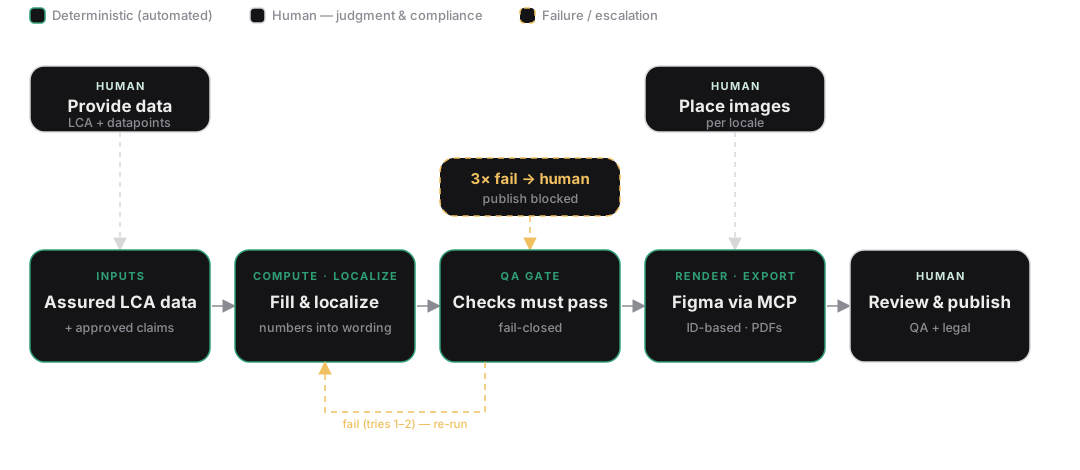
Most of the work was repeatable: the same assured lifecycle data flowing into the same document structure, over and over. That's a job for deterministic code, not human hours — and not, on its own, for an autonomous agent. The genuine judgment lived at the edges — interpreting the inputs, the imagery, and the final compliance call. So I designed a pipeline with a deterministic core and kept those judgment calls with people.
What I built
- Ingest third-party-assured LCA results into the tool as the single source of truth.
- Match that data to pre-cleared, approved claim language — deterministically, so the substance is never invented.
- Assemble deterministically — populate the approved content into the layout by ID, not by model discretion.
- Push to Figma via MCP to generate the design elements programmatically, instead of rebuilding each sheet by hand in external design software.
One rule held throughout: automation could shape the form — layout, assembly, formatting — but never the substance. Every published number and claim traces back to the assured data and pre-approved language, validation stayed deterministic, and the judgment calls — the data, the imagery, the final compliance read — stayed with people. In a compliance-sensitive domain, that boundary isn't optional.
What it changed
In 2026, 28 of 28 fact sheets across 14 programs cleared legal, PR, and GTM review with zero corrections. Production time per program fell 51%, hitting the 50% goal, and the production budget fell by over 90%: the fall launch needed no temporary staff, and rendering into Figma via MCP eliminated the need for an external design-platform contract. The pipeline is built for 14 marketplaces and 32 locales; 2026 was deliberately scoped to US English and Spanish to prove quality first.
The honest caveat
It's not magic, and it's not done. Human review still owns the final call — especially anything a regulator could read. The value wasn't replacing judgment; it was clearing away the repeatable design labor so people could spend their time on the parts that genuinely need a human.
